
Second Fridays – March
March 13th, 2026
International Visiting Scholar Gail Lewis
April 11th, 2026
Nicole Pardo, MD, Discussant Ali Kimmell, LCSW, CGP
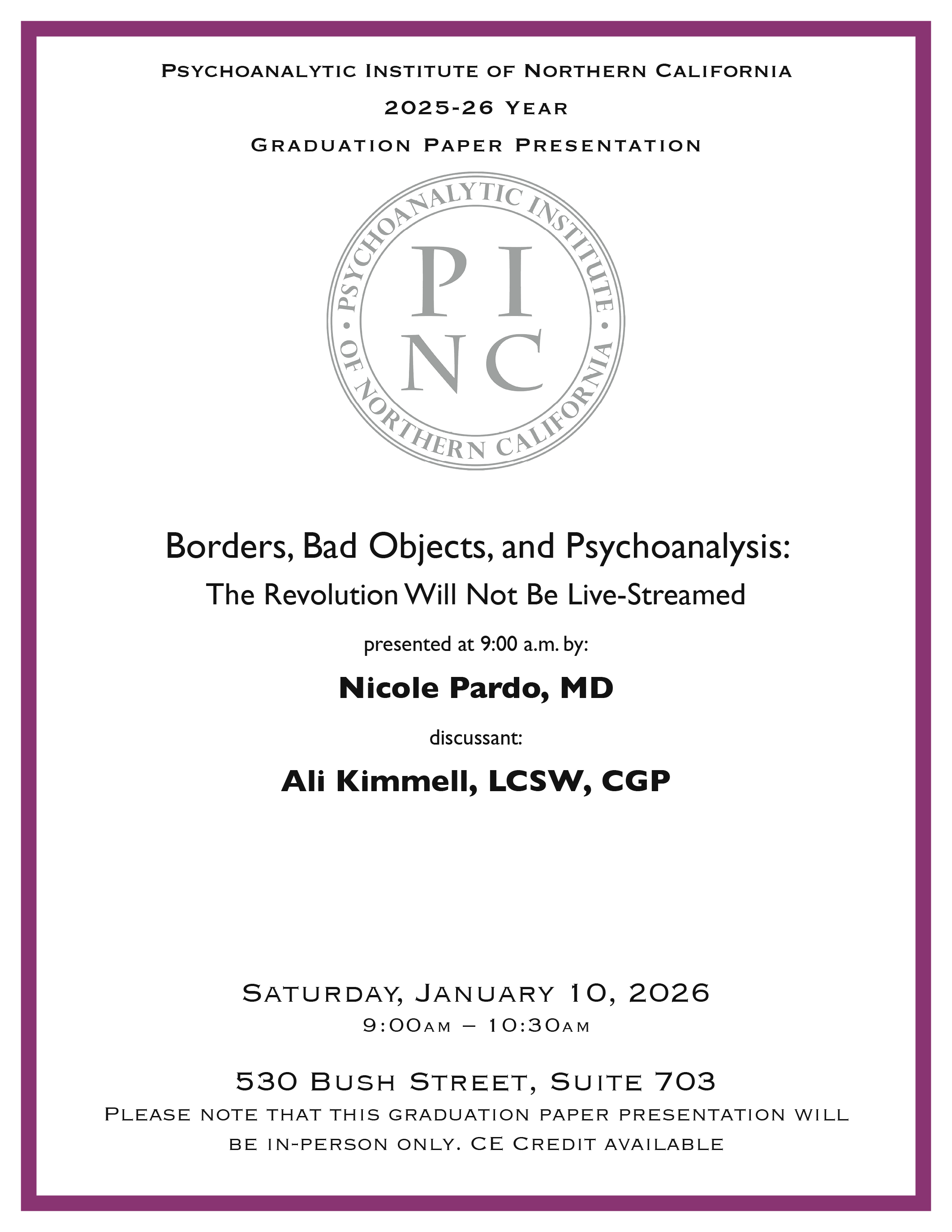 Drawing on Fairbairn’s theory of internalized bad objects, the paper posits an attendant omnipotent phantasy. Repetitions and re-enactments of this phantasy are examined through Saketopoulou’s framework of traumatophilic repetition. In dialogue with autotheory, group theory, and dream interpretation, as well as theorists including Dimen, Kimmell, and Dajani, the work examines repetitions within the field, and situates psychoanalysis within the larger macrocosm in which it is embedded.
The paper argues that the field’s enduring blind spots—its resistance to confronting power, social location, and its own “badness”—reveal an institutional omnipotent defense that mirrors destructive enactments of othering, disavowal, and fragmentation in the sociopolitical surround. Proposing a form of self-analysis for the field itself, this presentation invites psychoanalysis to metabolize its history of scapegoating and idealization, integrate group theory, and consider the social unconscious.
The discussant for Nicole’s paper will be Ali Kimmell, LCSW, CGP, founder of the Bay Area Group Therapy Center, where she leads weekly process therapy groups, therapist training groups, and provides consultation and teaching in group therapy.
Please note that this graduation paper presentation will be in-person only.
CE Credits offered: 1.5
Course Objectives
After completing this course participants will be able to:
db.pincsf.org/events 415-288-4050 ❖ 530 Bush St, Suite 703, SF CA USA ❖ office@pincsf.org
The Psychoanalytic Institute of Northern California (PINC) is approved by the American Psychological Association to sponsor continuing education for psychologists. PINC maintains responsibility for this program and its content. Visit db.pincsf.org/policies for policies and disclaimers.
| Free registration | |
| (1.5) CEs | $15.00 |